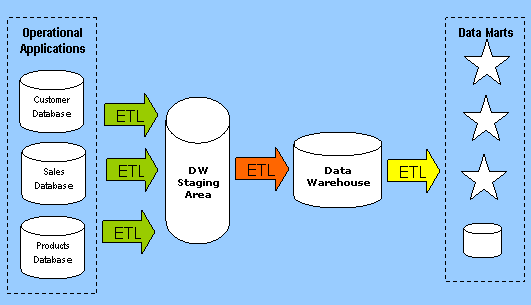
Typical Data Warehousing Environment
Guide to Data Warehousing and Business Intelligence
ETL technology is used to extract data from source databases, transform and cleanse the data and load it into a target database. ETL is an important component in the set Data Warehousing technologies.
The principal differences between ETL and conventional methods of moving data is its ease-of-use. A user friendly graphical interfaces is available to quickly map tables and columns between the source and target databases.
This approach is much faster than having to write and maintain conventional computer programs.
ETL also provides functionality to transform data values. For example, a source system might store months of the year as "01", "02"... "12" whereas another system might use a different convention (e.g. "Jan", "Feb"... "Dec").
ETL facilitates transformation of data values which is very important when data is being consolidated from multiple systems.
ETL technology can migrate data from different types of data structures (e.g. databases, flat files) and across different platforms (e.g. mainframe, server). It is also able to identify "delta" changes as they occur.
This approach allows ETL tools to copy only changed data, rather than having to do full data refreshes that can take much time and degrade system performance.
Consequently, ETL can copy operational databases into Data Warehouses environments in real-time or near real-time.