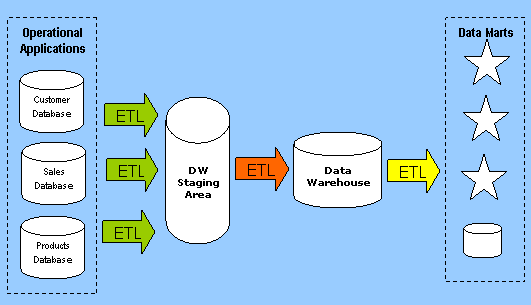
Typical Data Warehousing Environment
Guide to Data Warehousing and Business Intelligence
The principal reason why businesses need to create Data Warehouses is that their corporate data assets are often fragmented across multiple, disparate applications systems, running on different technical platforms in different physical locations. This situation does not enable good decision making.
When data redundancy exists in multiple databases, data quality often deteriorates. Poor business intelligence results in poor strategic and tactical decision making.
Individual business units within an enterprise are designated as "owners" of operational applications and databases. These "organizational silos" sometimes don't understand the strategic importance of having well integrated, non-redundant corporate data. Consequently, they frequently purchase or build operational systems that do not integrate well with existing systems in the business.
Data Management issues have deteriorated in recent years as businesses deployed a parallel set of e-business and ecommerce applications that don't integrate with existing "full service" operational applications.
Operational databases are normally "relational" - not "dimensional". They are designed for operational, data entry purposes and are not well suited for online queries and analytics.
Due to globalization, mergers and outsourcing trends, the need to integrate operational data from external organizations has arisen.
The sharing of customer and sales data among business partners can, for example, increase business intelligence for all business partners.
The challenge for Data Warehousing is to be able to quickly consolidate, cleanse and integrate data from multiple, disparate databases that run on different technical platforms in different geographical locations.
In the next section, the ETL portion of the Data Warehousing architecture is discussed.